
- Overview
- What causes aortic stenosis?
- Symptoms
- How aortic stenosis is diagnosed and graded
- Treatment
- Living with aortic stenosis
- For referring doctors
- Frequently asked questions
Overview
Aortic stenosis is narrowing of the valve between the heart’s main pumping chamber and the aorta. It is the commonest valve disease needing treatment in older people, affecting about one in eight over 75, and severe in about one in thirty (Osnabrugge et al, JACC 2013). Once it causes symptoms — breathlessness, chest tightness, dizziness or blackouts with exertion — survival without valve replacement is poor, and replacement, by open surgery or by keyhole TAVI, greatly improves it. No tablet slows the narrowing. A/Prof Jordan Fulcher assesses aortic stenosis at Central Sydney Cardiology and performs TAVI at Royal Prince Alfred Hospital and Strathfield Private Hospital.
What causes aortic stenosis?
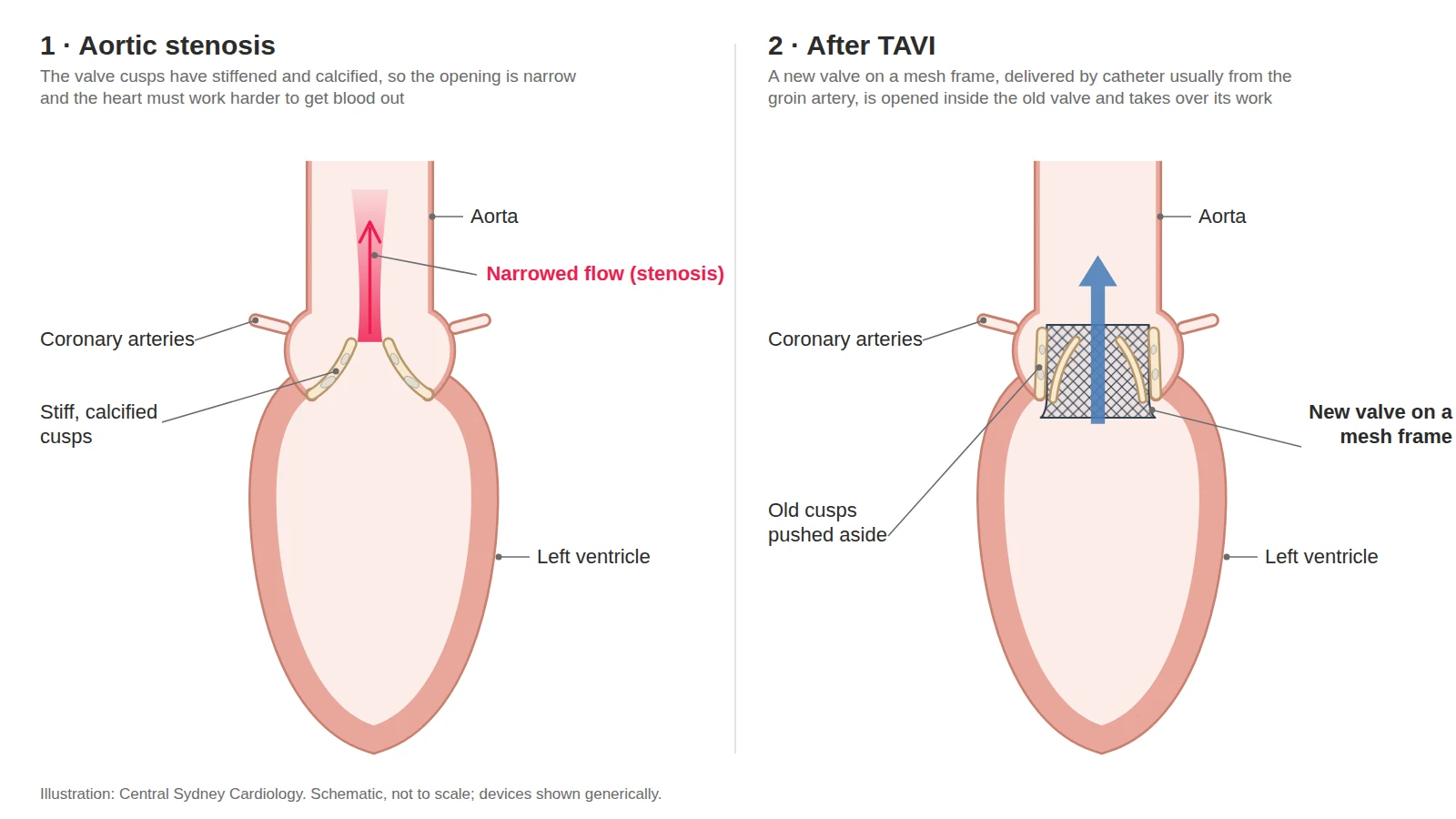
In most people it is calcific degeneration: over decades the three valve cusps thicken and accumulate calcium until they can no longer open fully. It is more common with age, high blood pressure, high cholesterol and lipoprotein(a), smoking, diabetes and kidney disease. About 1–2% of people are born with a two-cusp (bicuspid) valve, which wears out earlier — typically in the fifties and sixties — and may be accompanied by enlargement of the aorta. Rheumatic heart disease is a less common cause in Australia. The valve narrowing is progressive; the left ventricle thickens to push blood through the smaller opening, and eventually it can no longer compensate.
Symptoms
Aortic stenosis is silent for years and is often first noticed as a murmur. Symptoms appear once the narrowing is severe and usually with exertion: shortness of breath, tiredness, chest pain or tightness, light-headedness or fainting. Some people slow down gradually and attribute it to age. Any of these symptoms in someone with a known murmur or moderate stenosis warrants prompt review, because the risk of sudden deterioration rises sharply once symptoms begin.
How aortic stenosis is diagnosed and graded
Echocardiography is the key test. It measures the speed of blood across the valve, the pressure difference (gradient) and the valve opening area. Stenosis is graded severe when the peak velocity is 4 m/s or more, the mean gradient 40 mmHg or more, or the valve area 1.0 cm² or less (ESC/EACTS 2025). Some severe valves produce a low gradient because the heart pumps weakly or the ventricle is small; in these “low-flow, low-gradient” cases a dobutamine stress echocardiogram, a CT scan to measure valve calcium (severe above about 2,000 units in men and 1,200 in women), or invasive haemodynamic measurement settles the question. Mild stenosis is followed with echocardiography every two to three years and moderate stenosis yearly, because moderate stenosis carries a real risk in its own right — in the Australian National Echo Database, unadjusted five-year mortality was 56% with moderate and 67% with severe stenosis, against 19% with none; after adjustment for age and other factors the independent risk was about 1.5- to 2-fold (Strange et al, JACC 2019).
Treatment
Medication treats blood pressure, cholesterol and symptoms but does not slow the valve. Valve replacement is the only effective treatment and is recommended for people with severe stenosis and symptoms, and for people without symptoms whose heart function is falling (ESC/EACTS 2025 Class I). Since the EARLY TAVR trial (2024) showed that treating asymptomatic severe stenosis early halved the combined rate of death, stroke or unplanned cardiac admission compared with watchful waiting (HR 0.50, 95% CI 0.40–0.63) — a difference driven by fewer unplanned admissions, with no difference in deaths (Généreux et al, NEJM 2025), early intervention is also considered for selected patients without symptoms when procedural risk is low (Class IIa). There are two ways to replace the valve. Surgical aortic valve replacement through the breastbone remains the standard for younger patients at low surgical risk and for those needing other heart surgery. TAVI delivers a new valve through the femoral artery without opening the chest; the 2025 European guideline recommends TAVI for patients aged 70 or over with a three-cusp valve and suitable anatomy, surgery for those under 70 at low surgical risk, and a Heart Team decision for everyone else (Praz et al, Eur Heart J 2025). The choice weighs age and life expectancy, valve durability, anatomy on CT, other conditions and personal preference, and is made with the patient by the structural Heart Team. Without valve replacement the outlook is poor: in the PARTNER trial of patients unsuitable for surgery, half of those treated with medication alone had died within a year and two-thirds within two years (Leon et al, NEJM 2010; Makkar et al, NEJM 2012).
Living with aortic stenosis
Keep active within symptoms, control blood pressure and cholesterol, have dental care (valve infection is rare but serious), and keep echo appointments. Report new breathlessness, chest pain or dizziness promptly. Austroads’ Assessing Fitness to Drive standard for valvular heart disease says a person with symptoms on moderate exertion is not fit for an unconditional private licence, and commercial licence holders with symptomatic valve disease need specialist review; after valve replacement, including TAVI, the non-driving period is four weeks (private) and three months (commercial).
For referring doctors
When to refer. Any systolic murmur with symptoms, an abnormal ECG or signs; moderate aortic stenosis for surveillance planning and risk-factor management (annual echo; consider earlier referral where the gradient is rising fast or symptoms are equivocal); and all severe stenosis (Vmax ≥4 m/s, mean gradient ≥40 mmHg, AVA ≤1.0 cm² or ≤0.6 cm²/m²) whether or not symptomatic, given the Class I indication for symptomatic or LVEF <50% disease and the new Class IIa indication for early intervention in asymptomatic patients at low procedural risk (Praz et al, Eur Heart J 2025; ACC/AHA 2020: Otto et al, Circulation 2021). Symptomatic severe stenosis should be seen within weeks, not months.
What to send. Echocardiogram report (Vmax, mean gradient, AVA and indexed AVA, stroke volume index, LVEF), ECG, medication list, renal function and full blood count, and any prior cardiac imaging or surgery notes. TAVI work-up (gated CT aortography, coronary assessment, Heart Team review) is arranged through our rooms and performed at RPA or Strathfield Private Hospital; TAVI for Australian patients is performed at RPA. Referral channels are on the TAVI page and For Referring Doctors.
Frequently asked questions
Can aortic stenosis be treated with medication?
No medication slows or reverses the narrowing. Tablets help control blood pressure and symptoms, but valve replacement is the only treatment that changes the outcome.
I have moderate aortic stenosis. What should I do?
Have an echocardiogram every year, manage blood pressure and cholesterol, and report any new breathlessness, chest discomfort or dizziness straight away, as the valve can progress to severe within a few years.
How do I know whether I should have TAVI or surgery?
A structural Heart Team of cardiologists and cardiac surgeons reviews your echo, CT scan and general health. Broadly, TAVI is recommended from age 70 when the anatomy is suitable, surgery for younger patients at low risk, and either for people in between after discussion.
Can I keep driving with aortic stenosis?
For a private licence, yes if you have no symptoms. With symptoms on moderate exertion, Austroads advises against driving until the valve is treated; after treatment the non-driving period is four weeks for a private licence and three months for a commercial licence. Commercial licence holders with significant valve disease need specialist review.
Will my children inherit it?
Calcific stenosis is not directly inherited. Bicuspid aortic valve does run in families, so first-degree relatives of someone with a bicuspid valve are usually offered a screening echocardiogram.
Reviewed by A/Prof Jordan Fulcher, .