
For referring doctorsreferral criteria, work-up and how to refer
Left atrial appendage occlusion is a keyhole procedure that seals off the small pouch in the heart where most stroke-causing clots form in atrial fibrillation. It is an alternative to long-term blood thinners for people who cannot take them safely. A plug-like device (Watchman or Amplatzer Amulet) is delivered through a vein in the groin under general anaesthetic; the procedure takes about an hour and most patients go home the next day. A/Prof Jordan Fulcher performs LAAO at Royal Prince Alfred Hospital and Strathfield Private Hospital.
Atrial fibrillation, the appendage and stroke
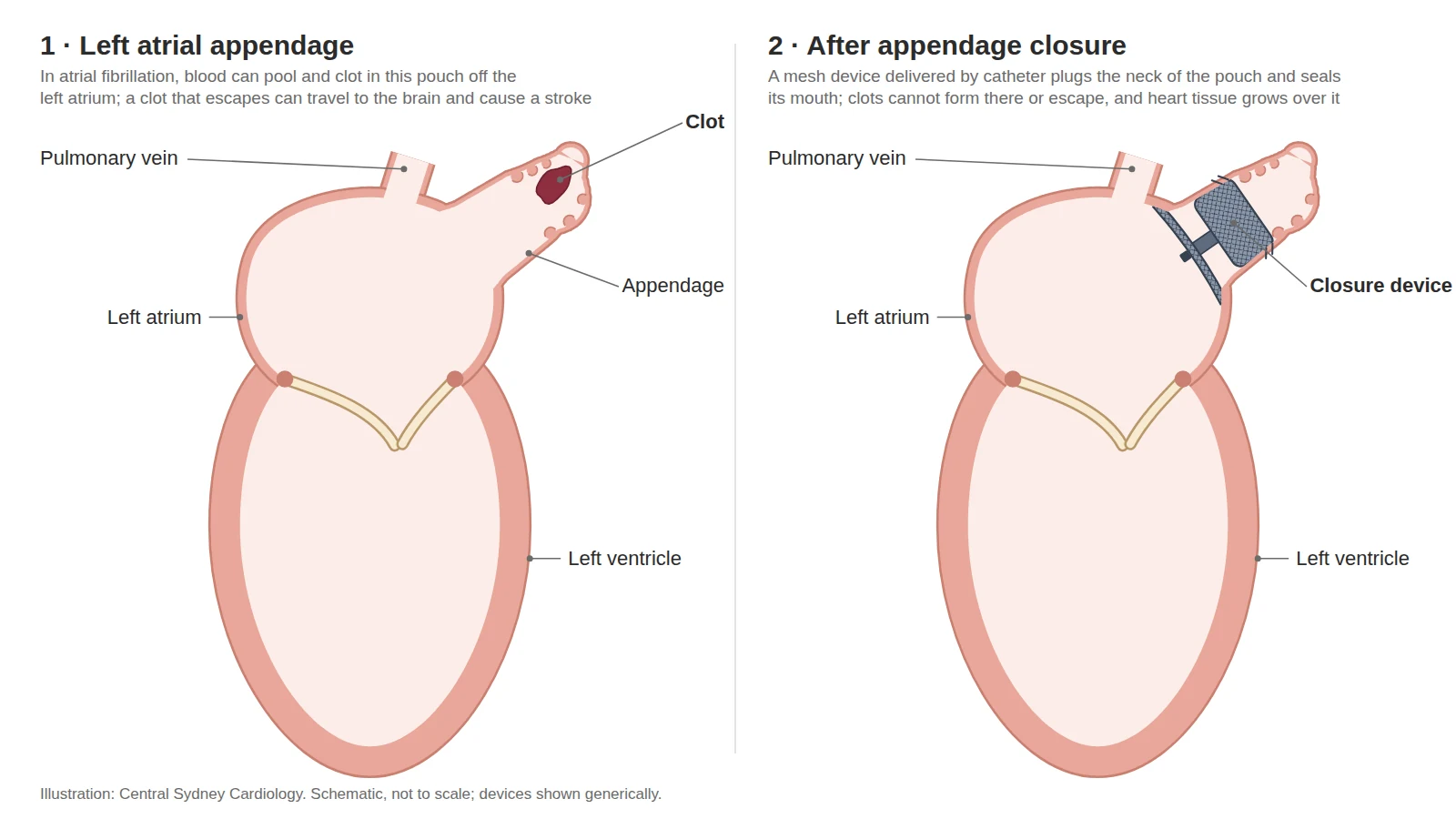
Atrial fibrillation (AF) is the most common heart rhythm disorder. Because the upper chambers quiver rather than contract, blood can pool and clot, and AF raises the risk of stroke about five-fold (Wolf et al, Stroke 1991). The left atrial appendage is a finger-shaped pouch off the left atrium; in AF that is not due to rheumatic valve disease, about 90% of clots found in the left atrium arise there (Blackshear & Odell, Ann Thorac Surg 1996). Anticoagulant tablets (apixaban, rivaroxaban, dabigatran, warfarin) are the standard, highly effective way to prevent AF-related stroke and remain first-line treatment. Some people cannot take them — because of a serious bleed, a bleeding-prone condition, or repeated falls with injury — and for them sealing the appendage offers another route to stroke prevention. Our Heart Rhythm Disorders page covers AF itself.
How LAA occlusion works
The procedure is performed in the cardiac catheterisation laboratory under general anaesthetic with transoesophageal echocardiography guiding every step. A catheter is passed from the femoral vein at the groin into the right atrium, then through a small puncture in the septum into the left atrium. The appendage has usually been measured by a preparatory cardiac CT but sizing is cross checked by echo and X-ray angiography. A device of matching size is advanced into its mouth and expanded, and its position and seal are checked before it is released. Over the following months the heart’s own lining grows over the device. The procedure usually takes about an hour.
Who is LAA occlusion for?
LAAO is considered for people with AF who are at increased risk of stroke and who have a lasting reason not to take anticoagulants — for example, a previous major bleed (particularly intracranial, or recurrent gastrointestinal bleeding without a treatable cause), a bleeding disorder, or a stroke despite properly taken anticoagulation. It is not a first-line alternative for people who can take anticoagulants: Australian, European and US guidelines position it for patients with contraindications to long-term anticoagulation (NHFA/CSANZ 2018; ESC 2024 Class IIb; ACC/AHA 2023 Class 2a where the contraindication is non-reversible).
Evidence
Compared with modern anticoagulant tablets (apixaban, rivaroxaban, dabigatran), LAAO was non-inferior for a combined outcome of stroke, bleeding and death in PRAGUE-17 over four years (Osmancik et al, JACC 2022). In the 3,000-patient CHAMPION-AF trial reported in 2026, LAAO was non-inferior for cardiovascular death, stroke or embolism with about half the non-procedural bleeding (HR 0.55, 95% CI 0.45–0.67) (Doshi et al, NEJM 2026). The evidence is not uniformly positive: in CLOSURE-AF, patients at high risk of both stroke and bleeding did no better with LAAO than with best medical care (Landmesser et al, NEJM 2026).
Risks
Common and minor: groin bruising, sore throat from the echo probe, temporary rhythm disturbance. Uncommon but serious, from large contemporary registries: bleeding around the heart needing drainage in about 0.5–1.5%, the device moving out of position in well under 1% (occasionally needing surgical removal), stroke or air embolism during the procedure in under 0.5%, and death in hospital in around 0.1–0.3% (Price et al, JACC CI 2022; Hildick-Smith et al, Eur Heart J 2020). A clot can form on the device surface before it is covered by heart tissue (device-related thrombus, about 1–4%), which is why antithrombotic tablets are needed for a period afterwards, and a small leak around the device is sometimes seen on follow-up imaging. Contrast reactions, kidney injury and leg-vessel injury are rare. Individual risk is assessed and discussed before any decision to proceed.
Recovery
You will lie flat for four to six hours after the procedure and usually stay one night. For the first weeks you will take blood-thinning tablets while the device is covered by the heart’s lining — either a short course of anticoagulant with aspirin, or aspirin with clopidogrel, typically for three to six months, followed by long-term low-dose aspirin. Do not stop these without consulting your cardiologist. Keep the groin dry for 48 hours; avoid baths, swimming and heavy lifting for a week; do not drive for at least 48 hours or as advised. A follow-up echocardiogram or CT at around six weeks to three months confirms the seal and checks for clot on the device before the tablets are reduced.
For referring doctors
Who to refer
Refer when all three are true.
- Atrial fibrillation needing stroke prevention. A previous stroke, TIA or embolism, or at least two of: age 65 or over, hypertension, diabetes, heart failure or an ejection fraction of 35% or less, and vascular disease.
- A lasting reason not to take an anticoagulant. An intracranial or other critical-site bleed; recurrent gastrointestinal bleeding without a treatable cause; a lifelong bleeding disorder; liver disease with impaired clotting (Child-Pugh B or C); advanced kidney failure (creatinine clearance under 15 mL/min) where warfarin is unsuitable; or hypersensitivity to the DOACs.
- Documented in writing, by a doctor other than the proceduralist. For Medicare funding the contraindication must be absolute and permanent.
Also refer a patient who has had an ischaemic stroke despite properly taken anticoagulation, and anyone whose bleeding risk on anticoagulation concerns you — an opinion is often the right first step.
Does not qualify on its own
- Falls risk
- Patient preference
- An unstable INR
Guidelines: NHFA/CSANZ 2018; ESC 2024 IIb C; ACC/AHA/ACCP/HRS 2023 2a B-NR.
Work-up
Send the referral with the bleeding history and its documentation. Where available, also include:
- Most recent echocardiogram
- ECG
- Medication list
- Pathology
We arrange cardiac CT, with or without transoesophageal echocardiography, to size the appendage and exclude thrombus.
Where and funding
- Consultations
- Central Sydney Cardiology, Newtown
- Work-up
- RPA or Strathfield Private Hospital
- Procedure
- RPA for public patients; Strathfield Private Hospital for private patients
- Funding
- Health funds cover LAAO.
How to refer
- HealthLink
- centrasc (EDI)
- structuralheart@cardiology.sydney
- Fax
- (02) 9336 2650
- Phone
- (02) 9336 2600 Mon–Fri 08:00–18:00
- After hours
- RPA Hospital (02) 9515 6111 — ask for the cardiologist on call
Mark referrals to A/Prof Jordan Fulcher.
LAA occlusion at Central Sydney Cardiology
A/Prof Jordan Fulcher performs left atrial appendage occlusion at Royal Prince Alfred Hospital and Strathfield Private Hospital with the Amplatzer Amulet device. Assessment is at Central Sydney Cardiology, Newtown.
Frequently asked questions
Can I stop blood thinners straight after the procedure?
Not immediately. A short course of antithrombotic tablets is needed while the heart’s lining grows over the device — usually a few months — after which most patients continue only low-dose aspirin. The exact plan depends on your bleeding history.
Is LAA occlusion as good as anticoagulant tablets?
For people who can take anticoagulants, tablets remain the standard of care and are what the guidelines recommend. Trials show LAAO gives comparable overall protection with less long-term bleeding, but with slightly more ischaemic strokes in the older warfarin-era trials (Reddy et al, JACC 2017). For people who cannot take anticoagulants, LAAO offers stroke protection they would otherwise not have.
Will I have a general anaesthetic?
Yes. The procedure is guided by a transoesophageal echocardiogram probe, so it is performed under general anaesthesia.
Is LAA occlusion covered by Medicare or my health fund?
Yes — for eligible patients, both Medicare and health funds cover LAAO.
How long will I be in hospital?
Most patients stay one night and return to normal activities within a week.
Reviewed by A/Prof Jordan Fulcher, .