
For referring doctorsreferral criteria, work-up and how to refer
TAVI (also called TAVR – Transcatheter Aortic Valve Replacement) is a minimally invasive procedure to replace a diseased aortic valve without open-heart surgery. Since its introduction, TAVI has transformed the treatment of aortic stenosis and is now performed in patients across all risk categories.
What is Aortic Stenosis?
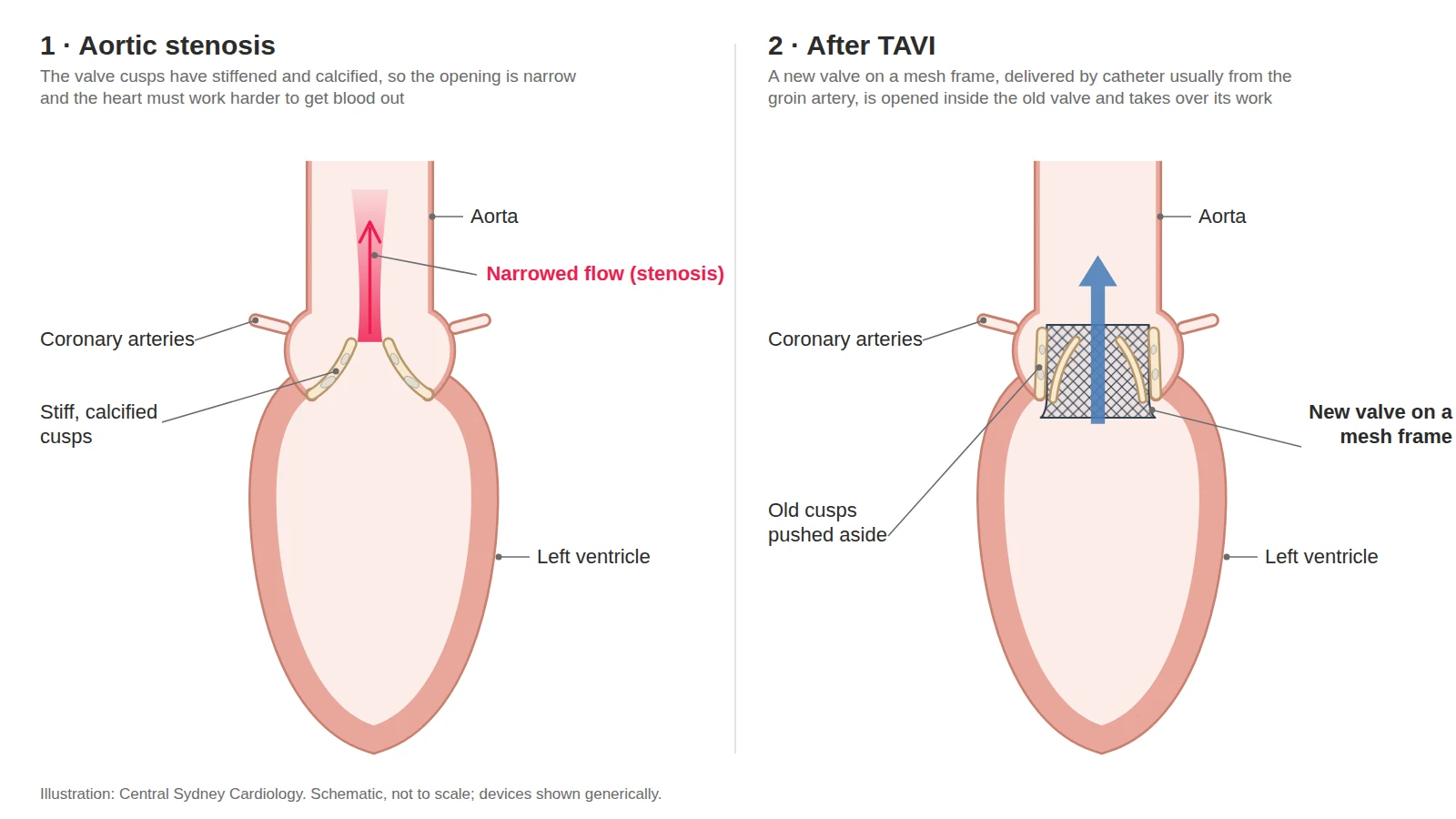
The aortic valve controls blood flow from the heart to the body. Aortic stenosis occurs when this valve becomes narrowed, usually due to age-related calcium deposits on the valve leaflets. Symptoms include:
- Shortness of breath, especially with exertion
- Fatigue and reduced exercise tolerance
- Chest pain or tightness
- Fainting or dizziness
How TAVI Works
During TAVI, a new valve made from biological tissue is compressed onto a catheter and inserted through an artery – most commonly the femoral artery in the groin. The catheter is guided to the heart under X-ray imaging. Once in position, the new valve is expanded inside the diseased valve, taking over its function immediately.
The procedure typically takes 1–2 hours and is most often performed under sedation with local anaesthetic; a general anaesthetic is used only when needed. Most patients spend one to two nights in hospital after TAVI.
Who is TAVI for?
TAVI treats severe aortic stenosis. Suitability is decided by a structural heart team after a workup which includes echocardiogram, TAVI CT scan and coronary angiography. It depends on valve anatomy, the access vessels and overall health rather than age alone. Patients at higher surgical risk and appropriately selected patients at lower surgical risk are both considered.
Risks
TAVI is a major cardiac procedure and no valve intervention is risk-free. Recognised complications include bleeding or injury at the access vessels, stroke, the need for a permanent pacemaker, leak around the new valve, and, rarely, emergency surgery or death. Individual risk depends on anatomy and general health; it is assessed as part of the comprehensive workup and discussed openly before any decision to proceed.
Recovery
Most patients spend one to two nights in hospital and are up and walking the day after the procedure. Austroads’ Assessing Fitness to Drive advises not driving a private vehicle for four weeks after valve replacement or repair, including TAVI; for commercial vehicle licences the advisory period is three months. Your treating team will confirm your individual guidance before discharge.
For referring doctors
Who to refer
- Severe aortic stenosis, across the surgical-risk spectrum. Randomised trials — including PARTNER 3, NEJM 2019 and Evolut Low Risk, NEJM 2019 — established TAVI as an alternative to surgical valve replacement in appropriately selected patients. Individual suitability is determined by structural Heart Team review.
- Full referral criteria, including the moderate and asymptomatic groups, are on the aortic stenosis page. Symptomatic severe stenosis should be seen within weeks, not months.
Work-up
Send with the referral, where available:
- Most recent echocardiogram report
- ECG
- Medication list
- Renal function
We arrange transthoracic echocardiography, ECG-gated CT aortography and routine bloods through our rooms.
Where
- Consultations
- Central Sydney Cardiology, Newtown
- Work-up
- RPA or Strathfield Private Hospital, including coronary angiography
- Procedure
- TAVI for Australian patients — public and privately insured — is performed by A/Prof Jordan Fulcher at RPA.
How to refer
- HealthLink
- centrasc (EDI)
- structuralheart@cardiology.sydney
- Fax
- (02) 9336 2650
- Phone
- (02) 9336 2600 Mon–Fri 08:00–18:00
- After hours
- RPA Hospital (02) 9515 6111 — ask for the cardiologist on call
Mark referrals to A/Prof Jordan Fulcher.
TAVI at Central Sydney Cardiology
Associate Professor Jordan Fulcher has undertaken advanced fellowship training in transcatheter valve therapies in Australia and the United Kingdom. He is actively involved in TAVI research, including participation in international clinical trials such as the SMART Trial and PROTECT-TAVI study.
Frequently Asked Questions
How long will I be in hospital?
Most patients go home one to two days after TAVI, depending on their recovery and supports at home.
Will I have a general anaesthetic?
Most TAVI procedures are performed under sedation with local anaesthetic; a general anaesthetic is used only when needed.
Is TAVI covered by Medicare or my health fund?
TAVI is performed at RPA Hospital for both public and privately insured Australian patients, and pre-procedure assessment can be arranged publicly or privately (including at Strathfield Private Hospital).
When can I drive again?
Austroads’ Assessing Fitness to Drive advises not driving a private vehicle for four weeks after valve replacement or repair, including TAVI; for commercial vehicle licences the advisory period is three months. Your team will confirm your individual guidance before discharge.
Structural heart procedures, including TAVI, for eligible international patients can be arranged at Strathfield Private Hospital — see International Patients.
Related: Heart Valve Disease | Associate Professor Jordan Fulcher
Reviewed by A/Prof Jordan Fulcher, .