
Renal denervation is a catheter procedure that quietens the nerves running along the kidney arteries, which help drive high blood pressure. It is an add-on for people whose blood pressure stays high despite three or more medications, or who cannot tolerate the medications they need. In sham-controlled trials it lowers 24-hour blood pressure by an average of about 4–6 mmHg — roughly the effect of one additional tablet — and the effect appears to persist for years. It does not replace medication and is not a first-line treatment. The procedure takes about an hour under sedation through the artery at the groin, with a short hospital stay. A/Prof Jordan Fulcher performs renal denervation at Royal Prince Alfred Hospital and Strathfield Private Hospital.
What is resistant hypertension?
Blood pressure is called resistant when it remains above 140/90 mmHg despite maximally tolerated doses of three blood-pressure medications from different classes — including a diuretic — and this is confirmed by home or 24-hour ambulatory monitoring rather than clinic readings alone. Before the label is applied, two things have to be excluded: “pseudo-resistance” (tablets not being taken as prescribed, white-coat effect, poor measurement technique) and secondary causes such as primary aldosteronism, sleep apnoea, kidney disease or narrowed kidney arteries. High blood pressure that is not controlled drives stroke, heart attack, heart failure and kidney failure; more on causes and treatment is on our Hypertension page.
How renal denervation works
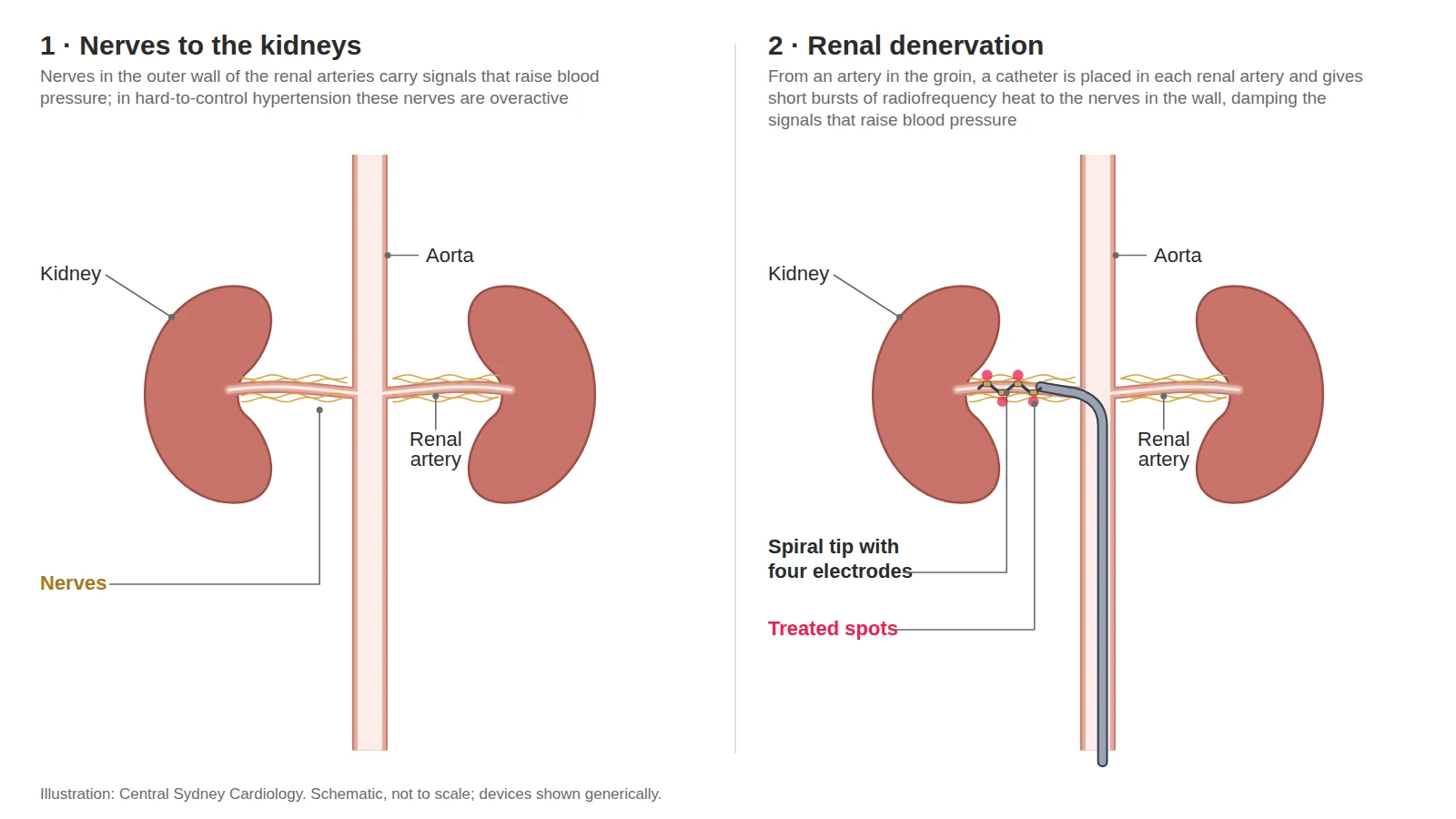
The kidneys and brain talk to each other through sympathetic nerves that run in the wall of the renal arteries. Over-activity of these nerves raises blood pressure by retaining salt and water, releasing renin and tightening blood vessels. In the procedure, performed in the cardiac catheterisation laboratory under sedation, a fine catheter is passed from the femoral artery at the groin into each renal artery under X-ray guidance. Energy — radiofrequency heat or focused ultrasound, depending on the device — is delivered at several points along the artery and its branches to interrupt the nerve signals, without damaging the artery itself. There is no implant. The procedure takes about an hour; most patients go home the same day or after one night.
Who is renal denervation for?
Renal denervation is considered for adults with confirmed resistant hypertension — uncontrolled on three or more medications including a diuretic — and adequate kidney function (eGFR ≥40 mL/min/1.73 m²), after secondary causes have been excluded, who choose it after a discussion of the likely benefit. It is also considered for people who cannot tolerate, or repeatedly cannot adhere to, the medications needed to control their pressure. The 2024 European Society of Cardiology hypertension guideline gives it a Class IIb recommendation in these groups when performed at an experienced centre after multidisciplinary assessment; the 2025 American guideline gives a similar Class 2b. It is not recommended as first-line treatment, in people with significantly reduced kidney function, or when a secondary cause has not been treated; unsuitable renal artery anatomy (very small or diseased arteries, previous stents, fibromuscular dysplasia) also rules it out. It is important to understand that the response varies between individuals and cannot be predicted in advance: some people gain a large reduction, some none.
Evidence
The first generation of trials was mixed, but since 2017 a series of sham-controlled trials — in which patients were randomised to real or pretend treatment without knowing which — has shown a consistent, modest treatment effect. In the pivotal SPYRAL HTN-OFF MED trial, denervation lowered 24-hour systolic pressure by 3.9 mmHg more than sham at three months (95% credible interval −6.2 to −1.6) with no medication on board (Böhm et al, Lancet 2020). In RADIANCE-HTN TRIO, patients with resistant hypertension on a standardised three-drug pill gained a further 4.5 mmHg daytime reduction (95% CI −8.5 to −0.3) (Azizi et al, Lancet 2021). Across ten sham-controlled trials (2,478 patients), the pooled reduction was 4.4 mmHg in 24-hour systolic pressure and 6.6 mmHg in office pressure, with no excess of vascular complications, kidney-artery narrowing or decline in kidney function (Vukadinović et al, Circulation 2024). Not every trial was positive: one radiofrequency trial on medication did not meet its primary endpoint, and a Japanese ultrasound trial showed no difference from sham. Longer follow-up suggests the effect is durable — at three years the sham-adjusted difference in ambulatory pressure was 10 mmHg in the SPYRAL HTN-ON MED pilot cohort (Mahfoud et al, Lancet 2022). No trial has yet shown that denervation reduces strokes or heart attacks; that expectation rests on the blood-pressure reduction itself.
Risks
Serious complications were uncommon in the sham-controlled trials. The main risks are those of any procedure through the femoral artery — bruising, bleeding or, in under 1%, a vessel injury needing repair — together with a small risk of damage to the kidney artery (narrowing has been reported in about 0.2% per year, similar to the background rate), contrast reactions and temporary kidney-function change. Back or flank pain during energy delivery is expected and managed with sedation and analgesia. There is no implant to fail. Registry follow-up to three years has not shown late complications (Mahfoud et al, Eur Heart J 2019).
Recovery
You will lie flat for a few hours while the artery puncture seals and go home the same day or the next morning. Keep the groin dry for 48 hours and avoid heavy lifting for a week; do not drive for 48 hours after sedation or as advised. Continue all your blood-pressure medications unless told otherwise — the effect of denervation builds over the following weeks to months, and medication is adjusted against home and ambulatory readings at follow-up rather than stopped straight away. Regular blood-pressure monitoring and review continue lifelong.
For referring doctors
Who to refer. Patients whose blood pressure is elevated despite three blood-pressure medicines, one of them a diuretic, at the highest doses they can tolerate. Other explanations (white-coat hypertension, poor compliance, secondary hypertension) need to be excluded. Kidney function needs to be reasonable — eGFR 40 or above. Patients who cannot tolerate several medicines, or repeatedly do not take them, are also worth discussing, especially when their cardiovascular risk is high. Renal denervation is an add-on to medication, not a replacement. The guidelines rate it as an option after multidisciplinary assessment rather than a routine treatment — ESC 2024 Class IIb (McEvoy et al, Eur Heart J 2024); ACC/AHA 2025 Class 2b (Jones et al, Circulation 2025); selection criteria in the ESC/EAPCI consensus (Barbato et al, Eur Heart J 2023) — and advise against it when eGFR is below 40 or a secondary cause is untreated. When in doubt, refer for an opinion.
Work-up. Where available, please send the ambulatory or home BP record, current and previously tried antihypertensives with doses and reasons for cessation, pathology including renal function and any renal imaging. We arrange renal artery imaging (CT or MR angiography, or duplex) to confirm suitable anatomy, and a discussion of expected benefit and cost.
Funding. Renal denervation is available for patients at Royal Prince Alfred Hospital. An application for Medicare listing (MSAC 1659.1) was considered on 30–31 July 2026 and the outcome is pending at the time of writing. Until listing, the procedure is self-funded in the private sector, and hospital costs are quoted before any decision.
How to refer. HealthLink (EDI: centrasc), fax (02) 9336 2650, or email structuralheart@cardiology.sydney, marked to A/Prof Fulcher. Enquiries: (02) 9336 2600, 08:00–18:00 Monday to Friday.
Renal denervation at Central Sydney Cardiology
A/Prof Jordan Fulcher performs renal denervation with the Symplicity Spyral radiofrequency system at Royal Prince Alfred Hospital and Strathfield Private Hospital, working with the patient’s GP and, where involved, a hypertension or renal physician to optimise medication before and after the procedure. Assessment is at Central Sydney Cardiology, Newtown.
Frequently asked questions
Will I be able to stop my blood-pressure tablets?
Usually not entirely. The average effect is similar to one additional medication, so most people continue treatment with the same or fewer tablets. Medication is adjusted at follow-up against home and ambulatory readings.
How much will my blood pressure fall?
On average about 4–6 mmHg on 24-hour monitoring (more in the clinic reading), but the response varies from person to person and cannot be predicted beforehand — some gain much more, some little. Trials suggest the effect lasts for years.
Is renal denervation covered by Medicare or my health fund?
Not at present, but it is currently available to patients at Royal Prince Alfred Hospital. The procedure is self-funded in private hospitals. Costs are provided in writing before any decision.
Is the procedure painful?
This depends on whether the procedure is performed under standard sedation or deeper sedation (with an anaesthetist present). Under routine sedation, energy delivery causes a deep ache in the back or flank for a few seconds at each point; sedation and pain relief are given during the procedure and the ache usually settles quickly afterwards.
Does it damage the kidneys?
Trials and registries to three years show no loss of kidney function compared with sham treatment, and narrowing of the kidney artery is rare (about 0.2% per year). People with significantly reduced kidney function (eGFR under 40) are not treated because safety in that group has not been established.
Reviewed by A/Prof Jordan Fulcher, .