
- CT Coronary Angiography (CTCA)
- CTCA at Central Sydney Cardiology
- What can a CT coronary angiogram show?
- Why might my cardiologist recommend CTCA?
- What happens during the scan?
- The scan is only part of the assessment
- Going beyond the standard CTCA: CaRi-Heart
- CTCA versus a coronary calcium score
- Frequently asked questions
CT Coronary Angiography (CTCA)
Detailed, non-invasive imaging of the coronary arteries
CT coronary angiography (CTCA) is a specialised CT scan that provides highly detailed images of the coronary arteries – the blood vessels that supply the heart.
It can show whether coronary atherosclerosis is present, where plaque is located, the type and extent of plaque, and whether any areas are causing significant narrowing.
Unlike a conventional coronary angiogram, CTCA does not require a catheter to be passed into an artery or a hospital admission.
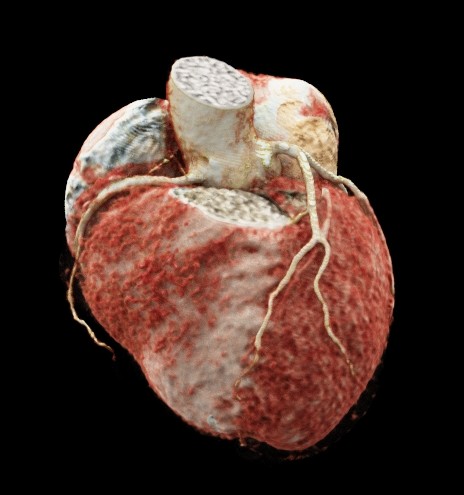
3D CT reconstruction of the heart and coronary arteries.
CTCA at Central Sydney Cardiology
Our cardiologists arrange CTCA at selected specialist cardiac imaging practices across Sydney, choosing the imaging provider and CT technology appropriate to the individual patient.
We work closely with experienced cardiac radiology teams and centres using advanced CT technology. The images and results are then reviewed by your cardiologist and incorporated into your overall cardiovascular assessment and treatment plan.
For patients requiring more advanced coronary imaging assessment, A/Prof Imre Hunyor has particular expertise in CT coronary angiography, coronary plaque assessment and advanced cardiac imaging, and is Director of Advanced Cardiac Imaging at Royal Prince Alfred Hospital.
What can a CT coronary angiogram show?
- Whether coronary artery disease is present.
- The location and severity of coronary artery narrowing.
- Both calcified and non-calcified coronary plaque.
- The overall distribution of coronary atherosclerosis.
- Certain higher-risk plaque characteristics.
- Coronary artery anatomy and congenital coronary abnormalities.
- Bypass grafts and, in selected circumstances, coronary stents.
One of the major strengths of CTCA is that it can detect early coronary atherosclerosis before it has produced a severe blockage. It can therefore provide information not only about the cause of symptoms, but also about future cardiovascular risk and prevention.
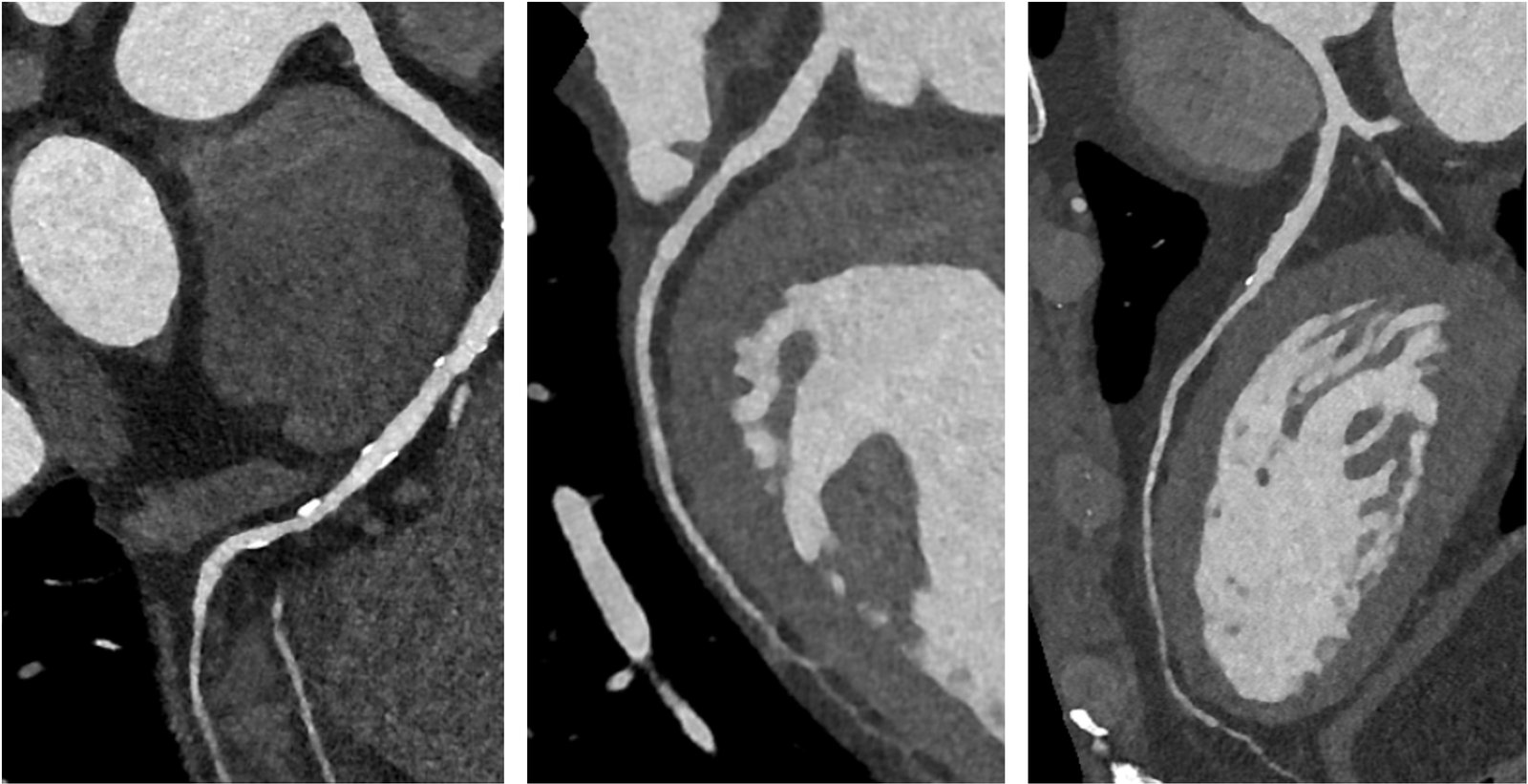
Examples of CT coronary angiography demonstrating detailed assessment of the coronary arteries and coronary plaque.
Why might my cardiologist recommend CTCA?
- Chest pain or chest discomfort where coronary artery disease is possible.
- Unexplained shortness of breath.
- Suspected coronary disease despite an inconclusive previous test.
- An unexpectedly high coronary calcium score.
- Strong family history or other important coronary risk factors in selected patients.
- Suspected coronary artery abnormalities.
CTCA is not the right investigation for every patient. Your cardiologist will consider your symptoms, cardiovascular risk, heart rhythm, kidney function, previous coronary procedures and other clinical factors when deciding whether CTCA or another test is most appropriate.
What happens during the scan?
CTCA is performed as an outpatient examination at a specialist imaging centre. ECG electrodes are attached to your chest so the scanner can synchronise the images with your heartbeat.
A small intravenous cannula is placed in your arm and iodine-containing contrast is injected during the scan. Medication may be given beforehand to slow your heart rate, and a short-acting nitrate spray is commonly used to widen the coronary arteries and improve image quality.
You lie on a table that moves through the CT scanner and will be asked to hold your breath briefly while the images are acquired. The actual image acquisition is very quick, although additional time is required for preparation and monitoring.
How long does it take?
Allow approximately 1–2 hours for the appointment, although the CT scan itself takes only a few minutes. The time required depends particularly on your heart rate and whether medication is needed before the scan.
How should I prepare?
Your imaging centre will provide specific preparation instructions. These commonly include avoiding caffeine before the test and bringing an up-to-date medication list.
Please let the imaging team know if you:
- Have previously had a reaction to CT contrast.
- Have significant kidney disease.
- May be pregnant.
- Take medications for erectile dysfunction.
- Have asthma or significant heart rhythm problems.
Always follow the instructions provided by the imaging centre arranging your examination.
The scan is only part of the assessment
A CT coronary angiogram produces a large and complex imaging dataset. Its clinical significance depends on more than simply whether a coronary artery is “blocked”.
At Central Sydney Cardiology, CTCA findings are interpreted alongside your symptoms, cholesterol levels, blood pressure, family history and other cardiovascular risk factors. Where appropriate, the images can also be reviewed for the amount and type of coronary plaque, rather than assessing stenosis alone.
This allows CTCA to help answer both:
- “Do I have a significant coronary narrowing?”
- “How much coronary disease do I have, and what does it mean for my future cardiovascular risk?”
Going beyond the standard CTCA: CaRi-Heart
Central Sydney Cardiology is Australia’s first CaRi-Heart Centre. CaRi-Heart is an advanced analysis performed using CT coronary angiography images that measures an imaging signal associated with coronary inflammation and combines this with other information to provide a more individualised assessment of future cardiac risk.
A standard CTCA tells us about coronary anatomy and plaque. CaRi-Heart adds information about coronary inflammatory activity.
In selected patients, CaRi-Plaque can also provide quantitative analysis of the amount and composition of coronary plaque.
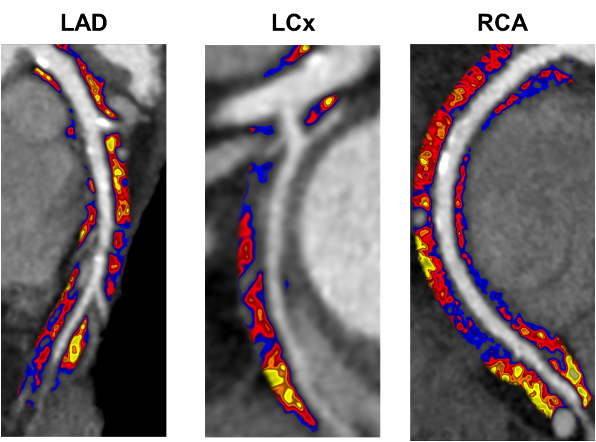
CaRi-Heart analysis of CT coronary angiography images, assessing imaging features associated with coronary inflammation.
Considering CaRi-Heart?
CaRi-Heart uses the images from your CT coronary angiogram, so no additional scan is required. However, the CTCA needs to be acquired and reconstructed using specific technical protocols for CaRi-Heart analysis.
If you may be interested in CaRi-Heart, please contact Central Sydney Cardiology before arranging your CTCA. We can help coordinate the scan with an appropriate imaging provider so that the images are suitable for both standard CTCA assessment and advanced CaRi-Heart analysis.
CTCA versus a coronary calcium score
A coronary calcium score and a CT coronary angiogram are different tests.
Coronary calcium score
A coronary calcium score is a quick CT scan performed without contrast that measures calcified plaque in the coronary arteries.
CT Coronary Angiography (CTCA)
A CT coronary angiogram uses intravenous contrast to directly visualise the coronary arteries. It can identify both calcified and non-calcified plaque and determine whether plaque is causing narrowing of the artery.
Depending on your age, symptoms and cardiovascular risk, your cardiologist can advise which test is more appropriate.
Frequently asked questions
Is CTCA the same as an invasive coronary angiogram?
No. CTCA uses a CT scanner and an intravenous contrast injection. An invasive coronary angiogram involves passing a catheter through an artery to the heart. CTCA does not require arterial catheterisation or hospital admission.
Does CTCA involve radiation?
Yes. CTCA uses X-rays. Modern cardiac CT techniques can acquire high-quality images using relatively low radiation doses, although the dose varies according to the patient and scanner.
Do I need contrast?
A CT coronary angiogram normally requires iodine-containing intravenous contrast so that the inside of the coronary arteries can be clearly seen.
Does Central Sydney Cardiology perform the scan?
The scan itself is performed at a specialist cardiac CT imaging centre. We arrange the investigation with appropriate imaging providers and review and interpret the results as part of your cardiology care.
Can CaRi-Heart be performed at the same time?
CaRi-Heart does not require another scan. It is an advanced analysis of the CTCA images. However, acquisition and reconstruction requirements are important, so if CaRi-Heart is being considered, it is preferable for Central Sydney Cardiology to arrange the CTCA beforehand.